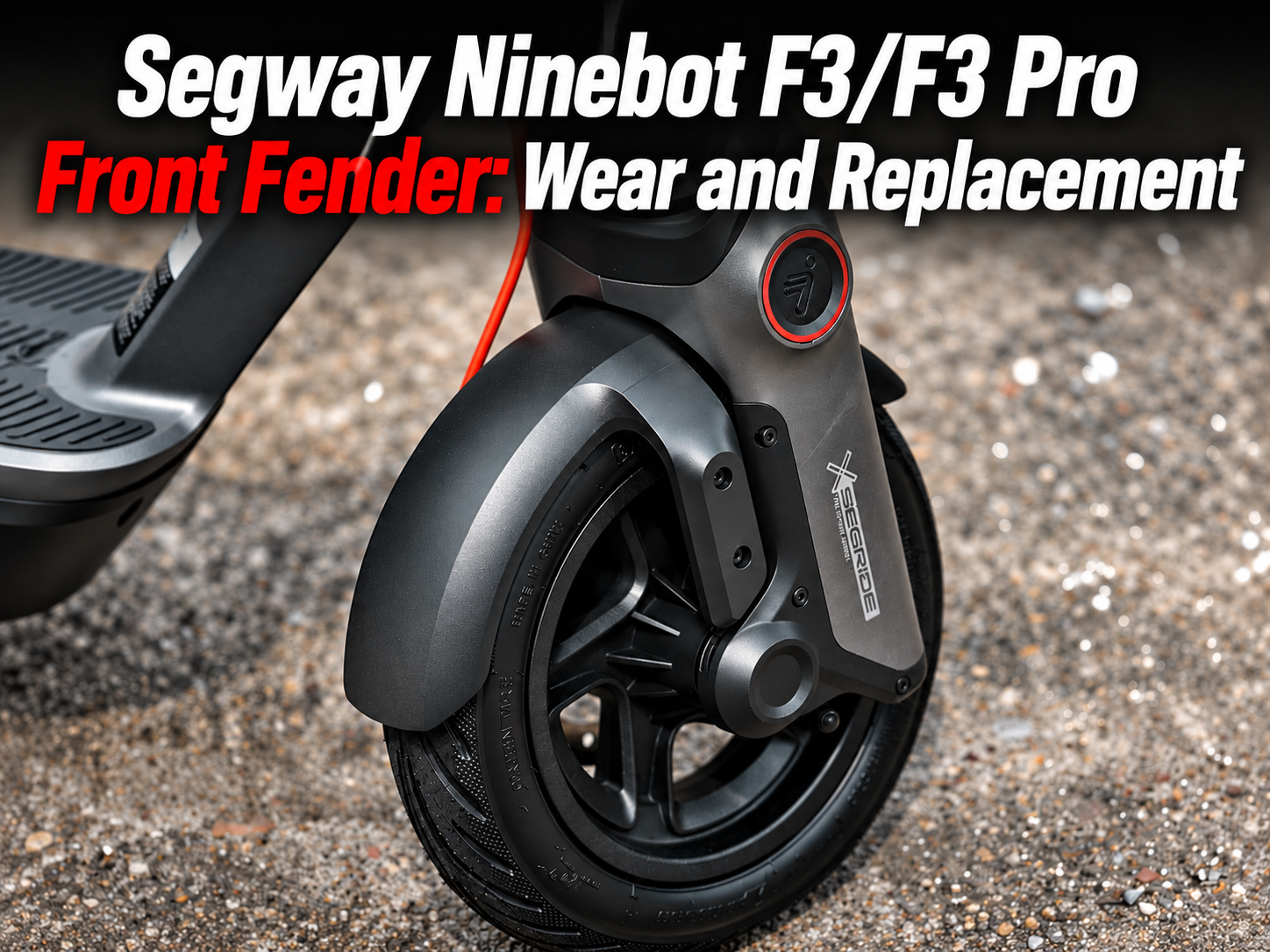
The Segway Ninebot F3/F3 Pro front fender is designed to protect the scooter and rider from water, mud, dust and debris thrown up by the front wheel.
Positioned directly above the front tire, the Segway Ninebot F3/F3 Pro front fender is particularly exposed to impacts and everyday riding conditions. A cracked, broken or loose front fender should be inspected and replaced when necessary.
In this guide, we explain its role, the main signs of damage and how to replace the front fender on a Segway Ninebot F3 or F3 Pro.
What Is the Role of the Segway Ninebot F3/F3 Pro Front Fender?
The main purpose of the Segway Ninebot F3/F3 Pro front fender is to limit projections coming from the front tire.
When riding on wet or dirty roads, the rotating tire can throw water, mud, gravel and other debris toward the scooter and rider.
The front fender helps protect:
- the rider from water and mud;
- the lower part of the scooter;
- components located around the front wheel;
- the steering area from excessive dirt and debris.
It also helps keep the scooter cleaner during everyday use.
Why Can the Segway Ninebot F3/F3 Pro Front Fender Become Damaged?
Unlike mechanical wear parts such as brake pads or tires, the Segway Ninebot F3/F3 Pro front fender does not have a fixed replacement interval.
Its lifespan mainly depends on riding conditions and possible impacts.
Common causes of damage include:
- a fall;
- an impact with an obstacle;
- stones or debris hitting the fender;
- repeated vibrations;
- loose mounting screws;
- incorrect handling or transport;
- excessive pressure applied to the fender;
- cracks developing around the mounting points.
A small crack can gradually become larger because the front fender is continuously exposed to vibrations while riding.
Signs of a Damaged Segway Ninebot F3/F3 Pro Front Fender
A damaged Segway Ninebot F3/F3 Pro front fender is usually easy to identify during a visual inspection.
Check the front fender if you notice:
- visible cracks;
- a broken section;
- deformation;
- excessive movement;
- loose mounting points;
- unusual vibrations;
- rubbing against the front tire;
- abnormal noises while riding.
If the fender moves excessively or touches the tire, stop using the scooter until the problem has been identified.
When Should You Replace the Segway Ninebot F3/F3 Pro Front Fender?
There is no specific mileage at which the Segway Ninebot F3/F3 Pro front fender must be replaced.
If the original part remains correctly secured and undamaged, it can continue to be used.
Replacement is recommended when:
- the fender is cracked;
- part of the fender is broken;
- the mounting points are damaged;
- the fender is significantly deformed;
- it can no longer be securely attached;
- it rubs against the front tire;
- damage occurred after a fall or impact.
A damaged mounting point is particularly important to inspect because simply tightening the screws may not solve the problem.
What Should You Check Before Replacing the Front Fender?
Before ordering a new Segway Ninebot F3/F3 Pro front fender, inspect the existing part and its mounting points.
First, check the mounting screws. Vibrations can gradually loosen them and create movement that may initially look like a damaged fender.
Also inspect:
- the mounting screws;
- the fender mounting points;
- the surrounding brackets;
- the front tire;
- the front wheel alignment;
- the clearance between the tire and fender.
If the fender itself is intact and the problem is only caused by loose hardware, correctly tightening the assembly may be sufficient.
If the plastic is cracked or the mounting points are broken, replacement is generally the better solution.
How to Replace the Segway Ninebot F3/F3 Pro Front Fender
Replacing the Segway Ninebot F3/F3 Pro front fender requires access to the mounting points around the front wheel.
Before starting, completely switch off the scooter and place it on a stable surface.
Then:
- Identify the front fender mounting points.
- Remove the screws securing the original fender.
- Carefully remove the damaged front fender.
- Inspect the mounting area for damage or dirt.
- Position the new front fender correctly.
- Reinstall the mounting screws.
- Tighten the assembly evenly.
- Check the clearance between the fender and the front tire.
Do not overtighten the screws, as excessive pressure can damage the mounting points.
Once installed, rotate the front wheel manually and make sure the tire does not touch the fender.
Video Tutorial: Segway Ninebot F3/F3 Pro Front Fender Replacement
A video tutorial can help you identify the mounting points and follow each step of the Segway Ninebot F3/F3 Pro front fender replacement.
Segway Ninebot F3/F3 Pro Front Fender
If your original front fender is cracked, broken or damaged, it can be replaced with a compatible part designed for the Segway Ninebot F3 and F3 Pro.


What Should You Check After Installing the New Front Fender?
After replacing the Segway Ninebot F3/F3 Pro front fender, check the installation before riding.
Make sure:
- all screws are correctly tightened;
- the fender is stable;
- the fender is correctly centered;
- the tire does not touch the fender;
- the front wheel rotates freely;
- there are no abnormal vibrations or noises.
Also turn the handlebar completely to the left and right to ensure that the installation does not interfere with steering.
Perform a short low-speed test before returning to normal riding.
How to Maintain the Segway Ninebot F3/F3 Pro Front Fender
The Segway Ninebot F3/F3 Pro front fender requires very little maintenance, but regular inspections can help prevent minor problems from becoming more serious.
Periodically:
- check the mounting screws;
- inspect the fender for cracks;
- remove accumulated mud and debris;
- check the clearance around the tire;
- inspect the fender after a fall or impact.
Avoid lifting, pushing or transporting the scooter by the front fender. It is not designed to support the scooter’s weight.
Keeping Your Segway Ninebot F3/F3 Pro Front Fender in Good Condition
The Segway Ninebot F3/F3 Pro front fender protects both the rider and scooter from water, mud and debris projected by the front wheel.
Although it does not require replacement at a specific mileage, a cracked, broken, loose or deformed fender should be replaced when it can no longer perform its role correctly.
After installing a new front fender, always check the mounting screws, tire clearance and front wheel rotation before riding.
For maintenance and repairs, choose Segway Ninebot F3/F3 Pro parts tested and approved by the Riders community, selected for their compatibility and reliability.


Leave a Reply